AI as a Thinking Partner (Not a Tool)
This lesson is available in multiple formats. The content is the same - choose the one that fits your learning style and current environment. You do not need to complete all formats.
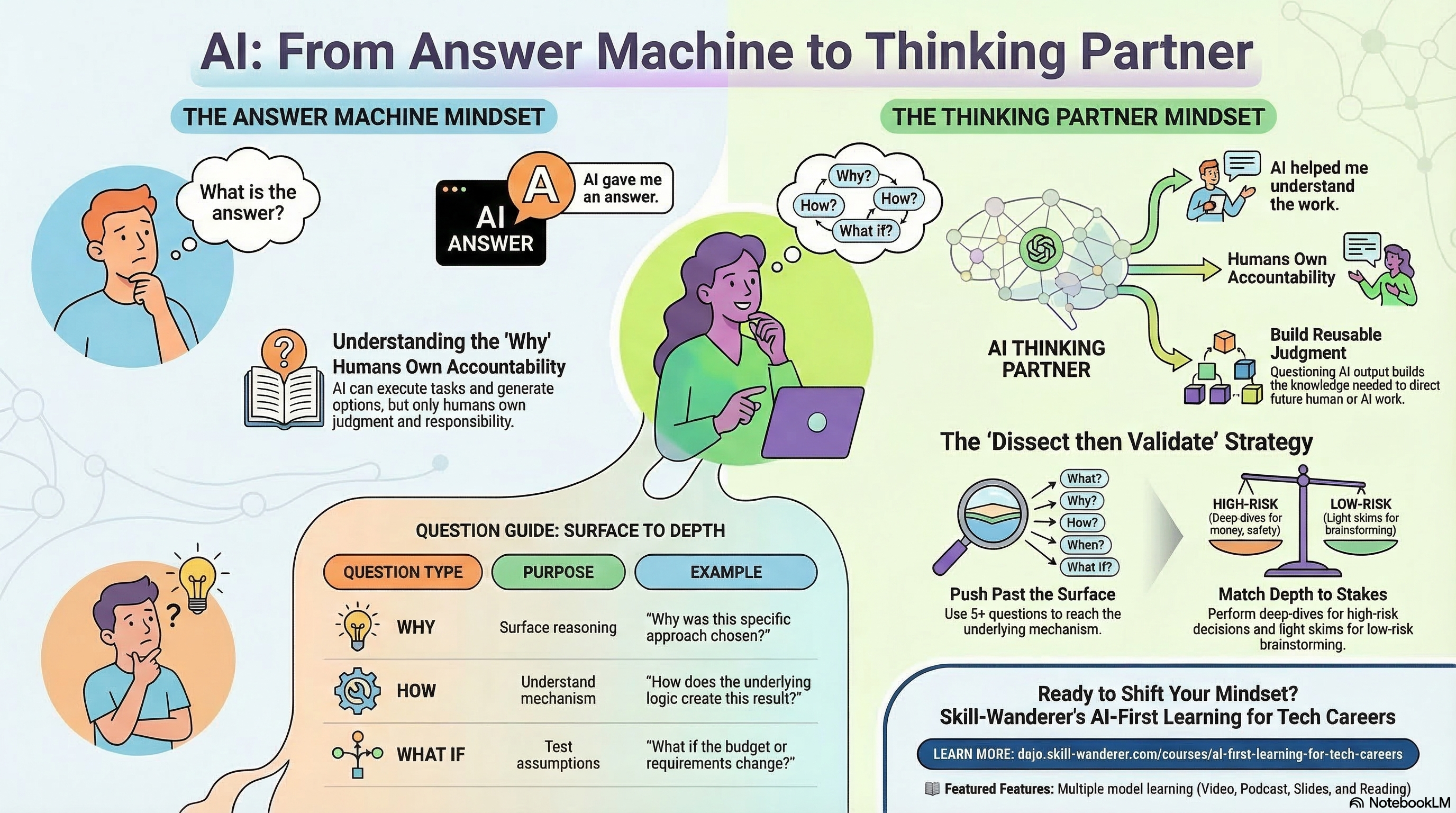
AI as a Thinking Partner (Not a Tool)
In the AI era, one of the most valuable skills is understanding how something works and what underlying mechanism makes it work. You do not need perfect mastery of every detail, but you do need enough understanding to explain what happened, why it happened, and whether it met the requirement.
That is why AI should not be treated as a magic answer machine. AI agents can execute tasks, generate options, and move quickly, but they do not own accountability. They do not truly know business responsibility, leadership judgment, or the full meaning of a requirement in the way a human owner, manager, or responsible contributor must. An AI agent can be an executor. It cannot be the accountable leader.
Good leaders do not personally do 100% of the work of every employee. They delegate, provide autonomy, and rely on capable people. The same will be true with AI. But if someone asks what your employee did, why it was done that way, or whether the result actually solved the problem, "I do not know" is not a strong answer. If you cannot understand and explain the work directed by AI, you reduce your own value.
Lesson goal: Shift from using AI as an answer machine to using AI as a thinking partner that helps you lead, verify, and understand work.
Core idea: In the AI era, your value increasingly comes from understanding enough to direct work responsibly, question results intelligently, and explain what was done with confidence.
1. A Familiar Scenario
Imagine two people using AI to help plan an event. The first person asks AI for a full event schedule, copies the plan, and feels finished because the output looks organized. The second person also uses AI, but asks what assumptions the schedule depends on, why activities were placed in that order, how timing was estimated, what could go wrong, and where the plan might fail if attendance or budget changes.
Both people may end up with a schedule. But if a manager, client, or team member later asks why the plan is structured that way, what risks remain, or whether it actually fits the real requirements, only one of them is in a strong position to answer. That is the difference between using AI as an answer machine and using AI as a thinking partner.
2. The Mindset Difference
The answer-machine mindset says: "AI gave me something useful, so I am done." The thinking-partner mindset says: "AI gave me something useful, so now I need to understand it well enough to lead it."
This is the real shift. In the AI era, your value is not only in producing output. It is in setting direction, checking quality, understanding mechanisms, and being able to explain what was done. AI can execute, but it does not carry accountability. You do.
You do not need 100% mastery of every detail. Good leaders never do every task themselves. But you do need enough clarity to verify the work and stand behind it.
3. Why This Matters
If you optimize only for speed, AI can make you look efficient while quietly weakening your judgment. You may deliver more outputs while understanding less about how they work. That becomes a problem the moment someone asks a serious follow-up question.
The better use of AI is slower by a small amount in the beginning, but stronger over time. When you question the output, inspect the mechanism, and test assumptions, you build reusable judgment. That is what makes you more valuable, because you can direct future human or AI work instead of only forwarding what a tool produced.
4. What The Shift Looks Like
In practice, the mindset shift is simple:
- From "AI gives me answers" to "AI helps me understand the work behind the answers."
- From "My job is to move fast" to "My job is to move fast and remain accountable."
- From "The AI handled it" to "I still need to explain what was asked, what was done, and why it makes sense."
- From "One answer is enough" to "I need enough questions to reach the underlying mechanism."
5. Verification Strategy: Dissect Then Validate
There is another reason this mindset matters: AI can sound convincing even when it is wrong. A useful-looking answer is not the same as a trustworthy answer. If you only ask, "Is this correct?" you may still miss weak assumptions, invented facts, or confident nonsense.
A better habit is not just "trust but verify." It is dissect then validate. First, break the answer apart so you understand the claim, the mechanism, and the assumptions. Then validate the parts that matter.
Useful verification moves include:
- Ask AI to explain the reasoning step by step.
- Ask AI to argue against its own previous answer.
- Ask what assumptions the answer depends on.
- Ask for sources, references, or the basis for a factual claim.
- Cross-check the important parts with another source, document, or human expert when the stakes are high.
The goal is not to distrust everything blindly. The goal is to avoid being impressed by an answer you have not really inspected.
6. Match Your Depth to the Stakes
In business, the 5 Whys technique is a well-known method for reaching root causes. Instead of accepting the first explanation, you keep asking "why" until you hit the real mechanism underneath. That same principle applies when working with AI, except in the modern AI era it does not need to stay as five literal "why" questions. It can become five or more questions across what, why, how, when, where, or what if, as long as you push past the surface.
That said, not every task deserves the same level of scrutiny. If you deep-dive into every tiny decision, you create analysis paralysis. Good judgment includes knowing when to investigate deeply and when to move quickly.
A simple rule:
- High-stakes tasks: Deep-dive. These include decisions that affect money, safety, deadlines, client trust, public communication, or important technical changes. Here, accountability is high, so ask at least five real questions and verify the answers.
- Low-stakes tasks: Skim faster. These include rough brainstorming, first drafts, idea generation, or low-risk formatting help. Here, speed can matter more than full dissection.
The point is not "always ask five questions no matter what." The point is: ask enough questions for the level of responsibility involved. The 5 Whys tradition gives you a proven starting point; adapt it to fit the stakes.
7. Micro-Action: Investigate Before You Accept
Take one small step now. Do not ask AI to finish a whole task for you. Instead, use it to help you understand something you need to explain clearly.
Choose one small problem, task, or output that you genuinely want to understand better. Good examples:
- A piece of code that behaves unexpectedly.
- A technical concept you can describe only vaguely right now.
- A process at work that you can follow but cannot fully explain.
- An AI-generated answer that sounds useful, but that you have not yet verified.
Then do this:
- Write down what you think is happening before you ask AI anything.
- Ask AI at least 5 real questions. Do not stop at the first good-sounding answer.
- Use a mix of question types such as what, why, how, when, where, and what if.
- Keep asking until you can describe the underlying mechanism in your own words.
- Finish by writing a short explanation of what the AI helped you understand and what would still need verification.
| Question Type | Purpose | Example |
|---|---|---|
| What | Clarify what is actually happening. | "What is happening here in plain language?" |
| Why | Surface reasoning, cause, or intent. | "Why was this approach chosen?" |
| How | Understand the mechanism behind the result. | "How does this produce the outcome?" |
| When or Where | Find conditions, risks, and limits. | "When would this fail?" or "Where are the weak points?" |
| What if | Test assumptions and changing requirements. | "What if the situation changes?" |
If you want a structure, use questions like these:
- "What is happening here, in plain language?"
- "Why does it work this way?"
- "How does the underlying mechanism create this result?"
- "When would this fail, and what conditions matter most?"
- "What should I be able to explain on my own if I am truly accountable for this work?"
As covered in section 6, the classic 5 Whys is your starting point. Adapt the depth to the stakes.
8. Reflection
- Do you usually use AI to investigate and understand, or mostly to get fast answers?
- How often do you accept useful-sounding output without understanding the mechanism behind it?
- When should you dissect an AI answer deeply, and when is a faster skim enough?
- What level of understanding do you think a responsible human should have when delegating work to AI?
- Which kind of question helps you move past surface explanations most effectively?
- If someone asked what the AI did for you today and why, how well could you explain it?
- What habit would make you more accountable and harder to replace when working with AI?
Key Takeaways
- This lesson is about mindset before method.
- Understanding how something works is a high-value skill in the AI era because accountable people must still explain and justify results.
- AI agents can execute tasks, but humans still own requirements, judgment, and accountability.
- Strong AI use includes dissecting answers and validating important claims instead of accepting useful-sounding output at face value.
- You do not need to perform 100% of the work yourself, but you do need enough understanding to lead and verify it responsibly.
- Asking at least five real questions is most useful for higher-stakes work; lower-stakes tasks can often be handled with a lighter pass.
- Good AI-supported learning strengthens your judgment so you become harder to replace, not easier to bypass.